


Inheritance Tax in Spain — Regional Guide
Use our calculator to see how much life insurance cover your family would need — including any inheritance tax liability.
Spain's inheritance tax (ISD — Impuesto sobre Sucesiones y Donaciones) is one of the most regionally varied taxes in the country. Where you live in Spain when you die determines the rules, rates and exemptions that apply to your estate — and the differences are enormous. This guide explains the rules region by region.
What Happens to Your Family's Income When You Die?
Your mortgage, bills and living costs don't stop — but if you're the main earner, your income does. Life insurance fills that gap, giving your family time to grieve without financial pressure. And in Spain there's an additional urgency: heirs must pay any ISD bill within 6 months of death.
When the main earner dies, the family salary disappears overnight. A life insurance lump sum can replace 10, 15 or 20 years of lost income — so your partner and children maintain their standard of living while they find their feet.
Your lender expects mortgage payments regardless of what happens to you. Life insurance linked to your outstanding balance ensures the home is paid off and your family keeps the roof over their heads — even if your income is gone.
If the estate is mostly property — illiquid assets — heirs may have no cash to pay the ISD bill within the 6-month deadline, and can't wait for a sale. Life insurance paid directly to named beneficiaries provides liquid funds to cover it without forcing a fire-sale.
University fees, driving lessons, a first deposit — your children's opportunities shouldn't depend on whether you're still here. A life insurance policy can ringfence a dedicated fund for their education and future, whatever happens.
How Spanish Inheritance Tax Works — The National Rate
Spain's inheritance tax (ISD — Impuesto sobre Sucesiones y Donaciones) is not a flat rate. At national level it is a progressive tax with rates from 7.65% to 34%, calculated on the net value inherited by each individual beneficiary. Unlike the UK, the tax is paid by the heir, not the estate — each beneficiary calculates and files their own return separately.
Progressive scale from 7.65% on the first tranche up to 34% on amounts above approximately €797,000 per heir.
Each heir is taxed individually on what they receive — not a single tax on the whole estate. Filing is on Modelo 650 within 6 months of death.
Each of Spain's 17 autonomous communities sets its own bonifications and personal reductions. As of 2026, 11 regions offer 99%+ relief for direct family — reducing the effective rate to near zero.
A wealth multiplier can push the effective rate higher for distant relatives or heirs with significant pre-existing assets — in extreme cases for unrelated heirs, effective rates can exceed 80%. All the more reason to live in a generous region.
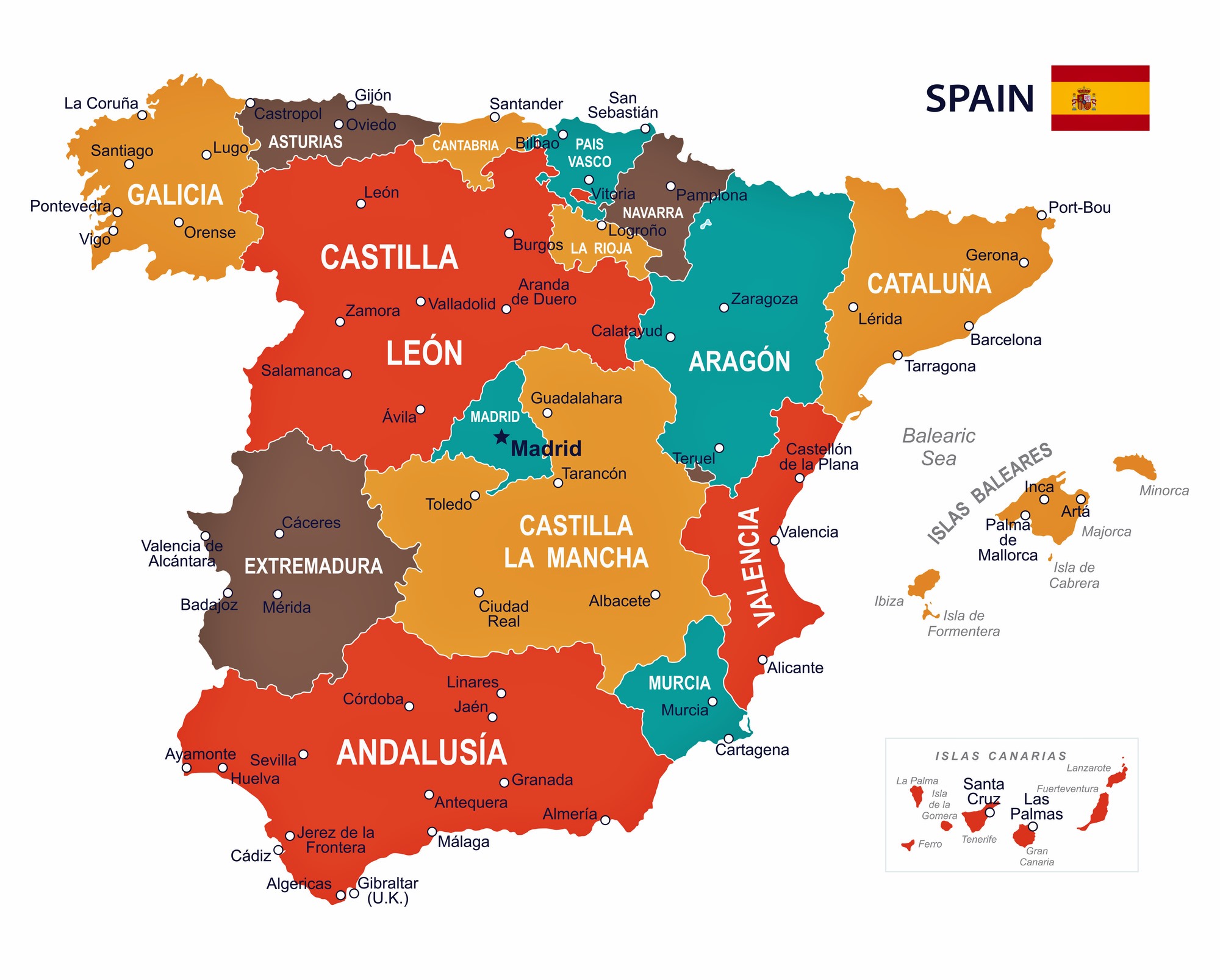
Choose Your Region — Click the Map
Open the full-page interactive map → or click any of the seventeen blue pins below — Galicia, Asturias, Cantabria, País Vasco, Navarra, La Rioja, Aragón, Cataluña, Castilla y León, Madrid, Castilla-La Mancha, Extremadura, Valencia, Murcia, Andalusia, Balearic Islands or Canary Islands — to read its detailed 2026 inheritance tax guide. Hover over the region itself on the map to highlight it.
 Galicia
Asturias
Cantabria
País Vasco
Cataluña
Extremadura
Madrid
Valencia
Andalusia
Navarra
La Rioja
Aragón
Castilla y León
Castilla-La Mancha
Murcia
Balearic Is.
Canary Is.
Galicia
Asturias
Cantabria
País Vasco
Cataluña
Extremadura
Madrid
Valencia
Andalusia
Navarra
La Rioja
Aragón
Castilla y León
Castilla-La Mancha
Murcia
Balearic Is.
Canary Is.
👇 Choose your region from the list below for its 2026 inheritance tax guide.
Or pick a region from the list
Extremadura
100% bonification on first €500k per heir for direct family since 2024.
Read guide →Navarra
Foral system — very generous treatment for direct family, low effective rates.
Read guide →La Rioja
99% bonification for direct family and spouses — among the most generous.
Read guide →Castilla y León
99% bonification for direct descendants and spouses — very generous.
Read guide →Castilla-La Mancha
99% bonification for Groups I and II since 2023 — near-zero for direct family.
Read guide →Balearic Islands
Significant reductions for direct family on estates up to €700,000.
Read guide →Canary Islands
99.9% bonification for direct descendants and spouses — effectively 0%.
Read guide →Calculate How Much Life Insurance Cover You Need
Use this calculator to estimate the life insurance cover your family would need — including an allowance for any inheritance tax liability based on your region. This is a rough guide only; speak to us for a personalised recommendation. Looking for the tax bill itself? Use our Spanish inheritance tax calculator.
Why Life Insurance Is the Smart Response to ISD
Understanding Spain's inheritance tax is only half the picture. The other half is doing something about it. Life insurance — structured correctly — addresses the most common financial shocks that follow a death in the family.
ISD must be filed and paid within 6 months of death. If the estate is mostly property, heirs often have no liquid cash to pay the bill — and can't wait for a property sale. A life insurance payout going directly to named beneficiaries provides cash on demand, right when it's needed most.
When the main earner dies, so does their salary — but the monthly bills do not. A lump-sum life insurance payout can replace 10, 15 or 20 years of lost income, buying the family time, stability and options.
Life insurance proceeds paid directly to named beneficiaries bypass the estate probate process and are paid out much faster than assets passing through a will. In most Spanish regions, those proceeds also qualify for the same regional bonifications as other ISD assets. Always name your beneficiaries directly in the policy — not through your will.
Life insurance proceeds paid to named beneficiaries are subject to ISD in the region where the policyholder was habitually resident at the time of death. In Madrid, direct descendants pay effectively 0%. In Catalonia, they may pay 15–20%+ on larger payouts. Use the calculator above to estimate the ISD on your payout and size your cover accordingly.
The right life insurance policy, correctly sized and structured with named beneficiaries, is often the single most cost-effective thing an expat family in Spain can do to protect their financial future — from both income loss and the ISD bill their heirs would otherwise face. Read our full guide to life insurance in Spain →
Frequently Asked Questions — Inheritance Tax in Spain
Protect Your Family — Get a Life Insurance Quote
Whether you need income replacement cover, mortgage protection, a fund to cover the ISD bill or simply peace of mind — speak to Turner Insurance for a free, no-obligation recommendation in plain English. We're authorised Generali agents and have been helping expats in Spain for over 25 years.
Turner Insurance does not provide tax advice. For inheritance tax planning, consult a qualified gestoría or abogado in Spain.