


Secret Coves Around Javea You Can Only Reach by Boat
Between Denia and Moraira the Costa Blanca hides sea caves, forbidden beaches and coves no road will ever touch. We’ve insured boats on this stretch of water for over 25 years — here are nine places worth casting off for, with a photo of each, and the rules that apply when you get there.
Javea (Xàbia in Valencian) sits on the most dramatic stretch of the Alicante coast: two great capes, cliffs of more than 100 metres, and water clear enough to count the posidonia leaves six metres down. The best of it — the carved cave of the Cova Tallada, the cathedral vault of the Cova dels Òrguens, the closed beach at Ambolo — can’t be reached by car at all. Some you can hike to if you’re determined; a few can only ever be seen from the water. This is our local guide to nine of them, by boat, kayak or paddleboard. (And if the boat lives here too, we’re the local agency — see boat insurance in Javea.)
The short version
- Three spots are genuinely sea-only — the Cova dels Òrguens, the Cova del Llop Marí and the flooded galleries of Els Arcs. Cala Ambolo has been closed by land for over 15 years, so it’s boat-only in practice too.
- The Cova Tallada needs a free advance permit from 15 June to 15 October 2026 — even if you arrive by kayak or swim in. Bookings open only 10 days ahead, five people per booking.
- The waters off Cap de Sant Antoni are a marine reserve: six-knot limit, no anchoring (use the buoys), no fishing of any kind.
- Never anchor on posidonia seagrass. It’s prohibited across the Valencian Community and fines under Ley 42/2007 run up to €200,000 — the Guardia Civil actively checks Javea bay with an underwater viewer.
- Within 200 m of any beach the speed limit is 3 knots; jet skis must stay outside the bathing strip and enter perpendicular to the shore.
- Third-party liability insurance is compulsory for most powered craft and every jet ski — and it’s part of the paperwork checked afloat.
The nine coves at a glance
| Spot | Where | How you get there | Worth knowing |
|---|---|---|---|
| Cova Tallada | Cap de Sant Antoni | Kayak, SUP, swim — or a hard 45–60 min trail | Free permit needed 15 Jun–15 Oct |
| Cova dels Òrguens | Under the Cap de la Nau lighthouse | Sea only — small boat or kayak | Javea’s biggest sea cave |
| Illa del Portitxol | Off Cap Prim | Boat or kayak; snorkel the shallows | Private island — don’t land |
| Cala Sardinera | North face of Cap Prim | Boat, or a 1 km footpath | Mooring buoys offshore; zero services |
| Cala Ambolo | Below Cap Negre | Sea only — land access closed | Admire from the water |
| Cova del Llop Marí | North of La Granadella | Swim, kayak or SUP only | Buoys keep motor craft out |
| Cala Llebeig | Benitatxell/Moraira border | Boat, or a 2.3 km cliff trail | Old fishermen’s huts on the shore |
| Cala dels Testos | Below Morro Falquí | Kayak/SUP ~400 m from Moraig | Land route needs ropes — go by sea |
| Els Arcs | South end of Cala Moraig | Swim or paddle in flat calm | Twin rock arches over the sea |
1. Cova Tallada — the carved cave of Cap de Sant Antoni
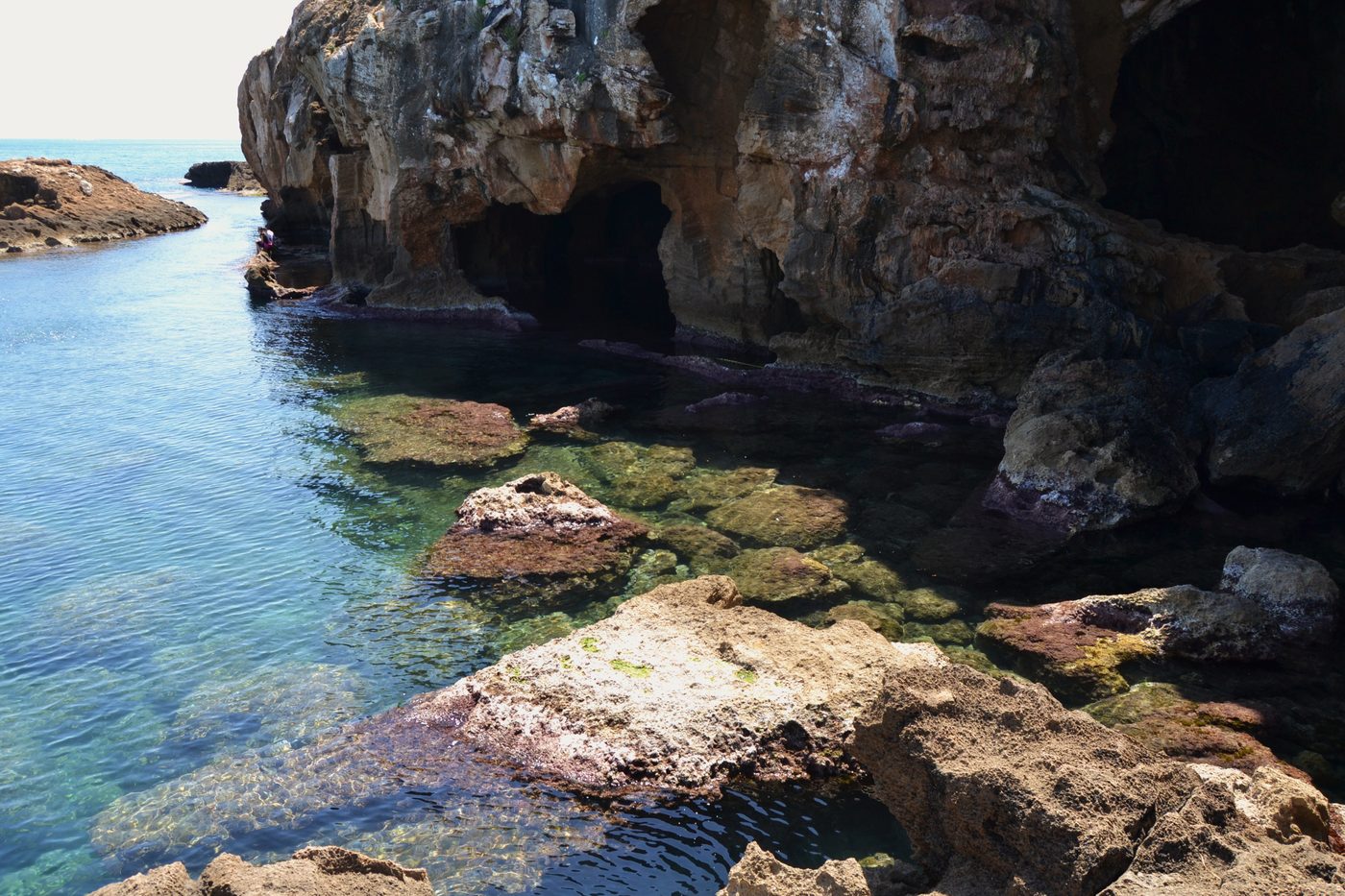
Half natural cave, half medieval quarry, the Cova Tallada (“the cut cave”) sits at sea level on the Javea side of Cap de Sant Antoni. Its soft tosca sandstone was carved out by hand for centuries — blocks from here went into Denia Castle — and the chisel marks still ribbon the walls. Several chambers are flooded, so you can paddle or swim right inside; ceramics found here date back to the 11th century, and Philip III is recorded as having visited in 1599.
It sits inside the Cabo de San Antonio marine reserve, so boats can’t anchor or land — moor at the authorised buoys and swim in, or arrive by kayak or paddleboard. In summer 2026 access is regulated: a free advance booking is compulsory from 15 June to 15 October (plus the Easter weeks), reservable at most 10 days ahead through the Generalitat’s portal, five people per booking, with a 90-minute stay. The rule applies however you arrive — on foot, by kayak or swimming — and it is checked.
Getting there: by sea from Javea’s port round the cape (6-knot limit in the reserve), or a rough 45–60 minute trail from Les Rotes in Denia. Take water; there’s no shade and no phone signal.
2. Cova dels Òrguens — the organ-pipe cave under the lighthouse
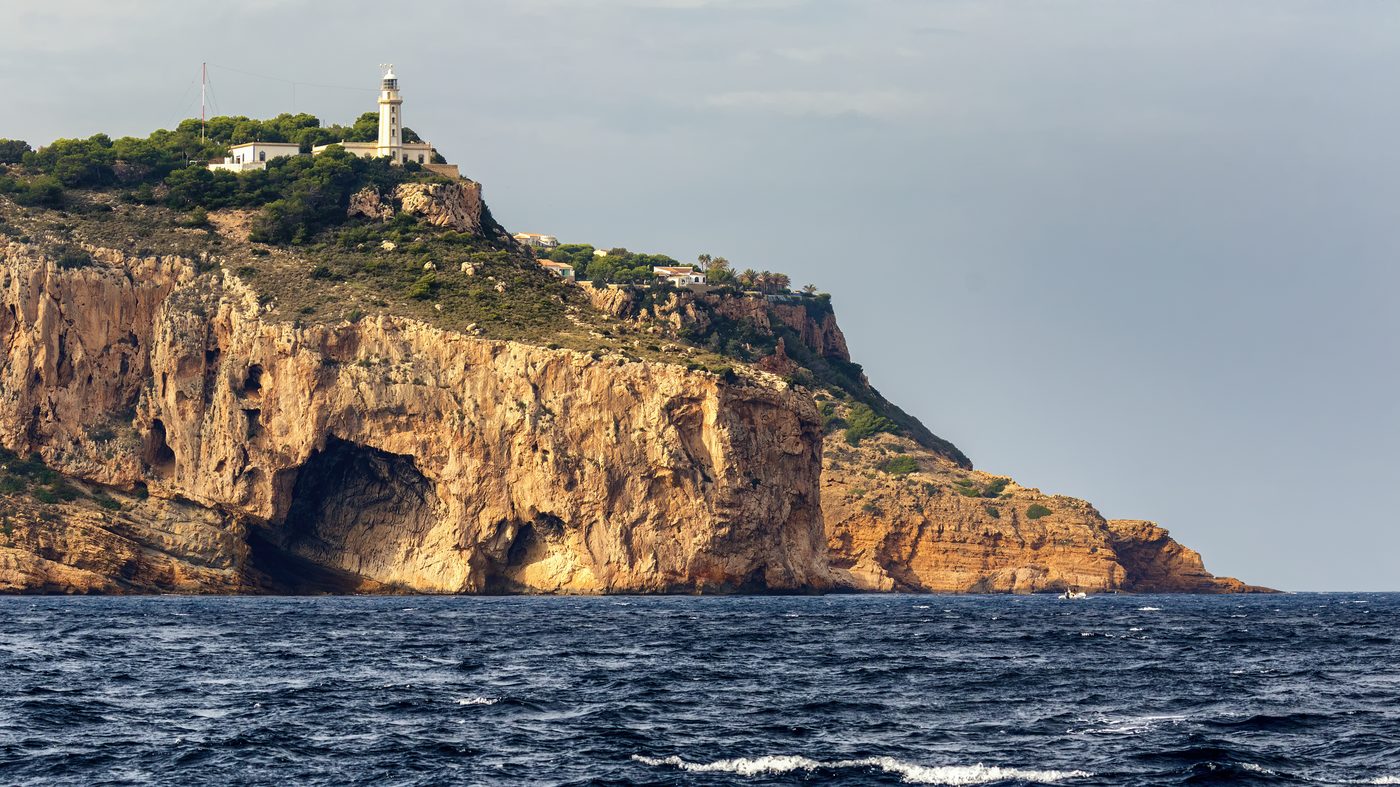
Directly beneath the Cap de la Nau lighthouse, where the cliffs top 100 metres, opens the largest sea cave on this coast — roughly 35 metres deep with a vault around 20 metres high. Its name comes from the rock formations inside, said to resemble cathedral organ pipes; the naturalist Cavanilles was describing it admiringly as far back as the 18th century, and it reportedly appears in the film Uncharted.
There is no path down and never will be: this one is sea-only. Small boats can nose into the enormous mouth on a calm day, and guided kayak tours run from La Granadella between July and October. Treat it with respect — the sea off the cape turns quickly, and the swell inside a cave is always bigger than it looked outside.
Getting there: around 15 minutes by boat south from Javea bay, or a guided paddle from Granadella. Flat-calm days only.
3. Illa del Portitxol — the island with a Roman seabed
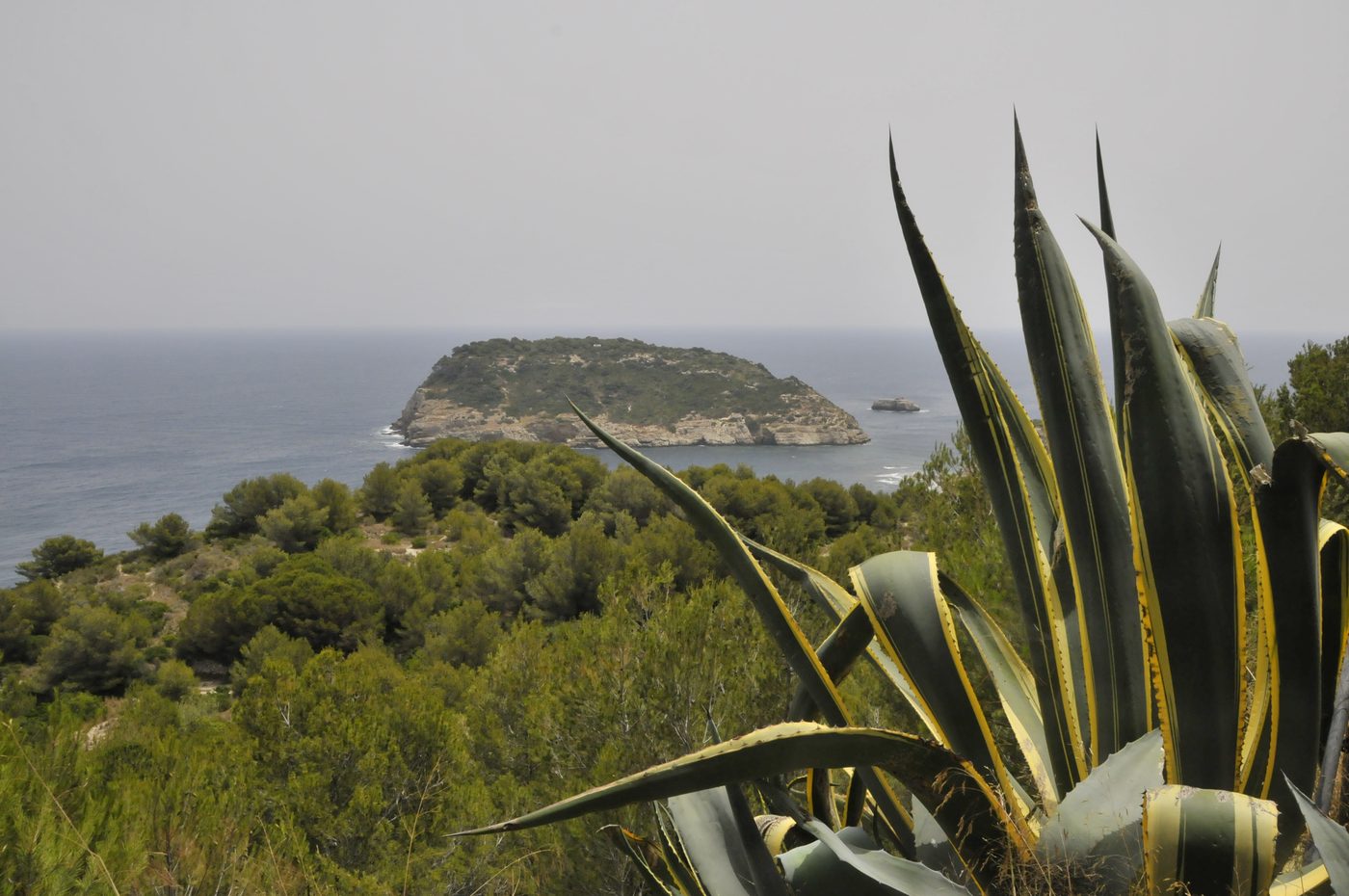
The postcard of Javea: a round, 75-metre-high island 183 metres off Cap Prim, ringed by some of the clearest snorkelling water in the province. What you can’t see from the surface is why it’s protected — the island and its seabed are a declared archaeological site (BIC since 2019), with the remains of a Roman villa, around a hundred ancient anchors, amphorae, 53 Roman gold coins and at least three suspected wrecks. The town is working on turning it into Spain’s first underwater museum, with a buoyed “anchors route” for snorkellers and divers.
Two things to know from the helm: the island is private property — stay on the water — and from 2026 the town is closing the shallow strait between island and coast to boats with a line of marker buoys, to protect bathers, the archaeology and the seagrass. Go around the outside; it was always the more sensible line anyway, with the isthmus barely three metres deep.
Getting there: 10 minutes by boat from the port; kayaks reach it comfortably from Cala Barraca. Moor on sand or buoys, never on the meadows.
4. Cala Sardinera — the fishermen’s cove on Cap Prim
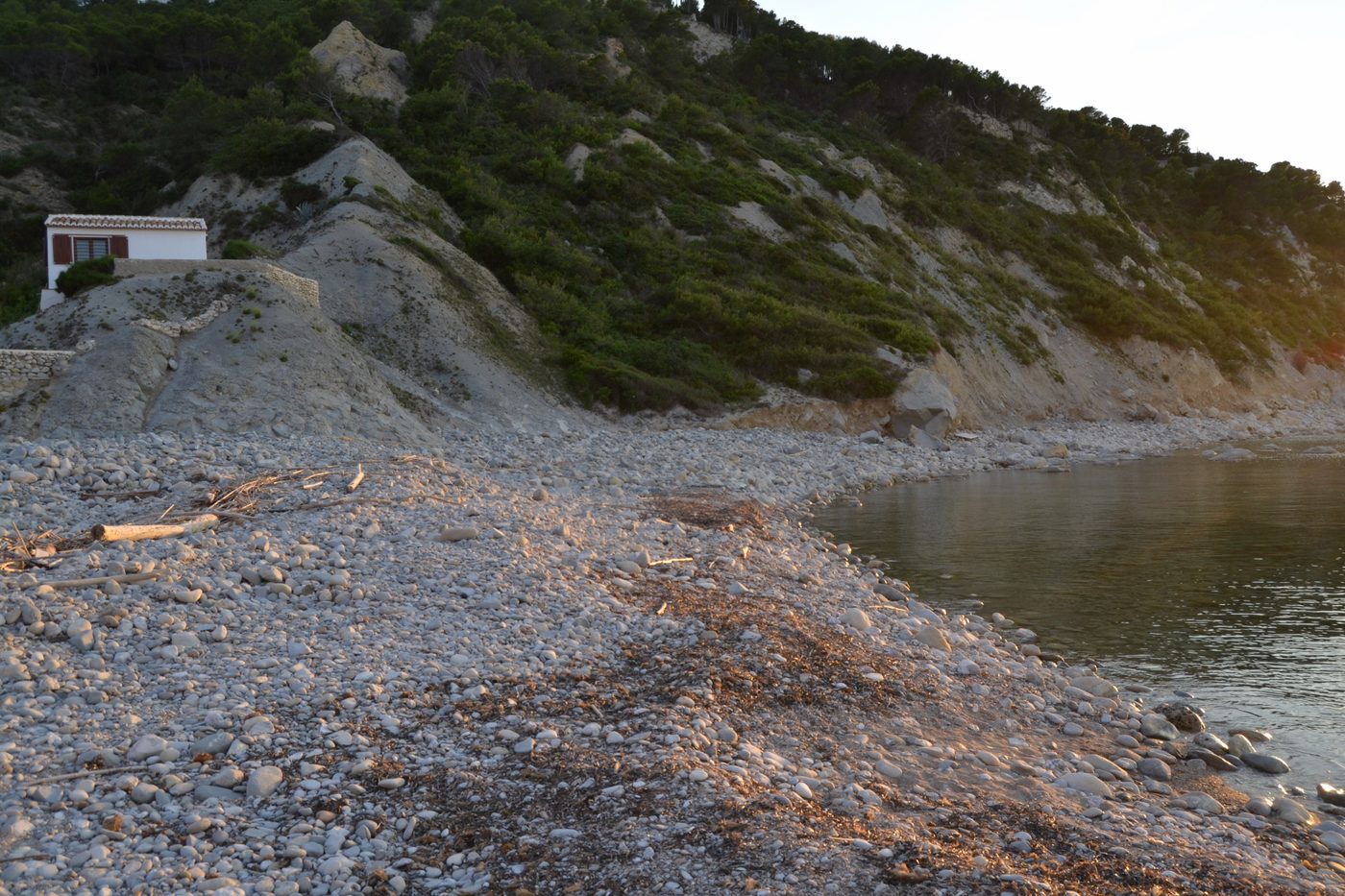
A 200-metre sweep of gravel and boulders on the sheltered north face of Cap Prim, named after the sardinals — the fine sardine nets fishermen once cast here at dawn and dusk. There is nothing on it: no bar, no showers, no lifeguard, and that’s exactly the appeal. Facing into Javea bay, it’s usually calm when the southerlies are working the other side of the cape.
Sardinera is honest about being “semi-secret”: you can walk in on the SL-CV 98 footpath from the Creu del Portitxol viewpoint in 20–30 minutes. But most visitors arrive by water, and the town has laid mooring buoys offshore — use them, because much of the bay floor here is protected seagrass.
Getting there: five minutes by boat from the Portitxol anchorage, or the 1 km path from the mirador. Proper shoes if you walk; the last stretch is steep.
5. Cala Ambolo — the forbidden beach
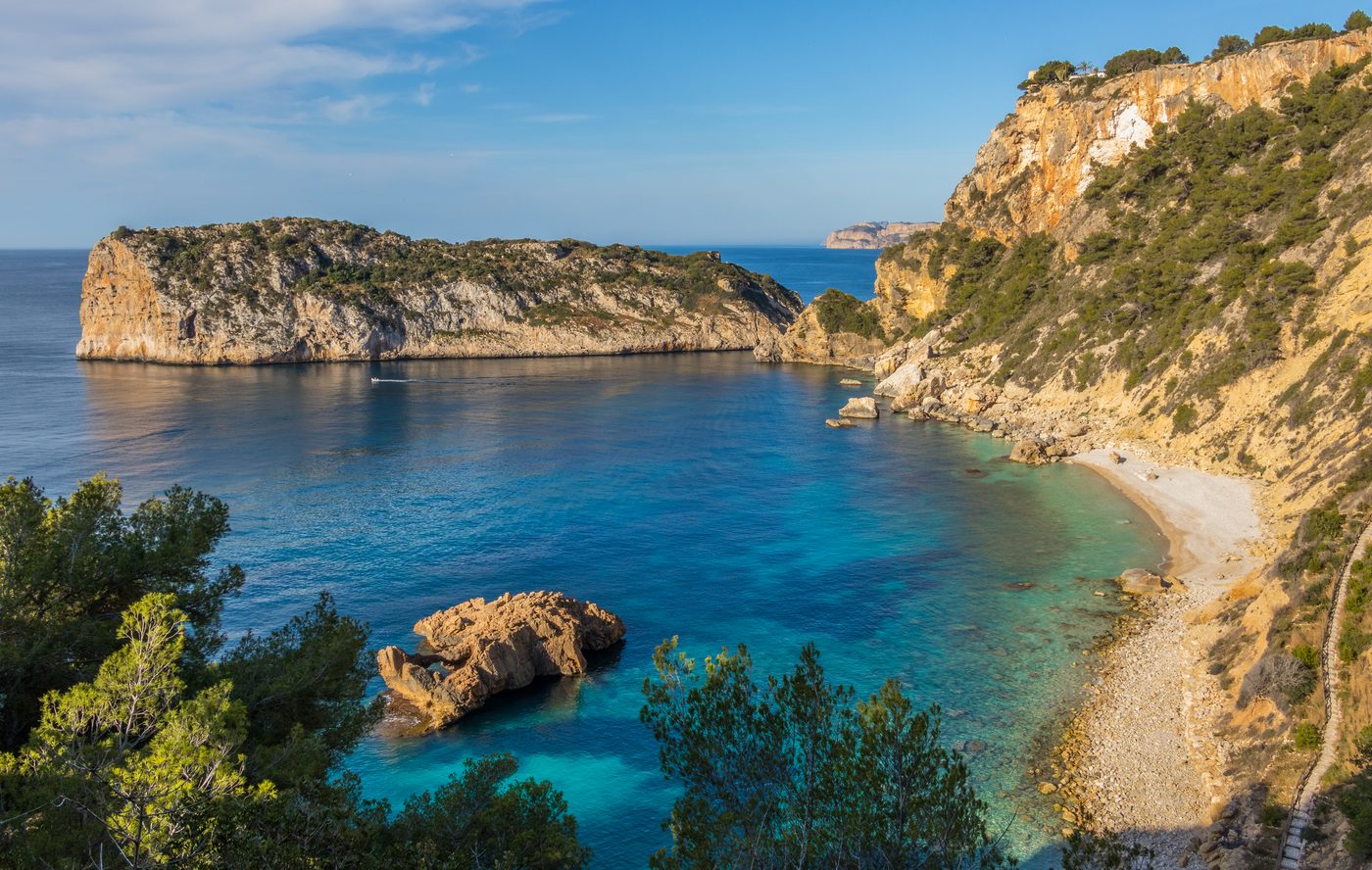
Sheltered by the little Illa del Descobridor below Cap Negre, Ambolo was for years Javea’s official naturist beach — and many locals still call it the most beautiful cove in town. It has been officially closed by land since around 2009 because of serious rockfall from the cliff above; the protective netting has degraded, boulders still come down, and since 2024 the town has kept a locked gate and a summer guard on the access roads.
That makes it, in practice, a boat-only sight. The honest advice is to admire it from the water: the beach itself remains closed, and there are reports of visitors who landed by kayak being moved on. From a hull’s length out you lose nothing — the cliff, the islet and the colour of the water are the show.
Getting there: a short run north from La Granadella or south from Cap de la Nau. Keep clear of the beach and watch the depth — the islet channel is shallow and rocky.
6. Cova del Llop Marí — the sea-wolf’s cave
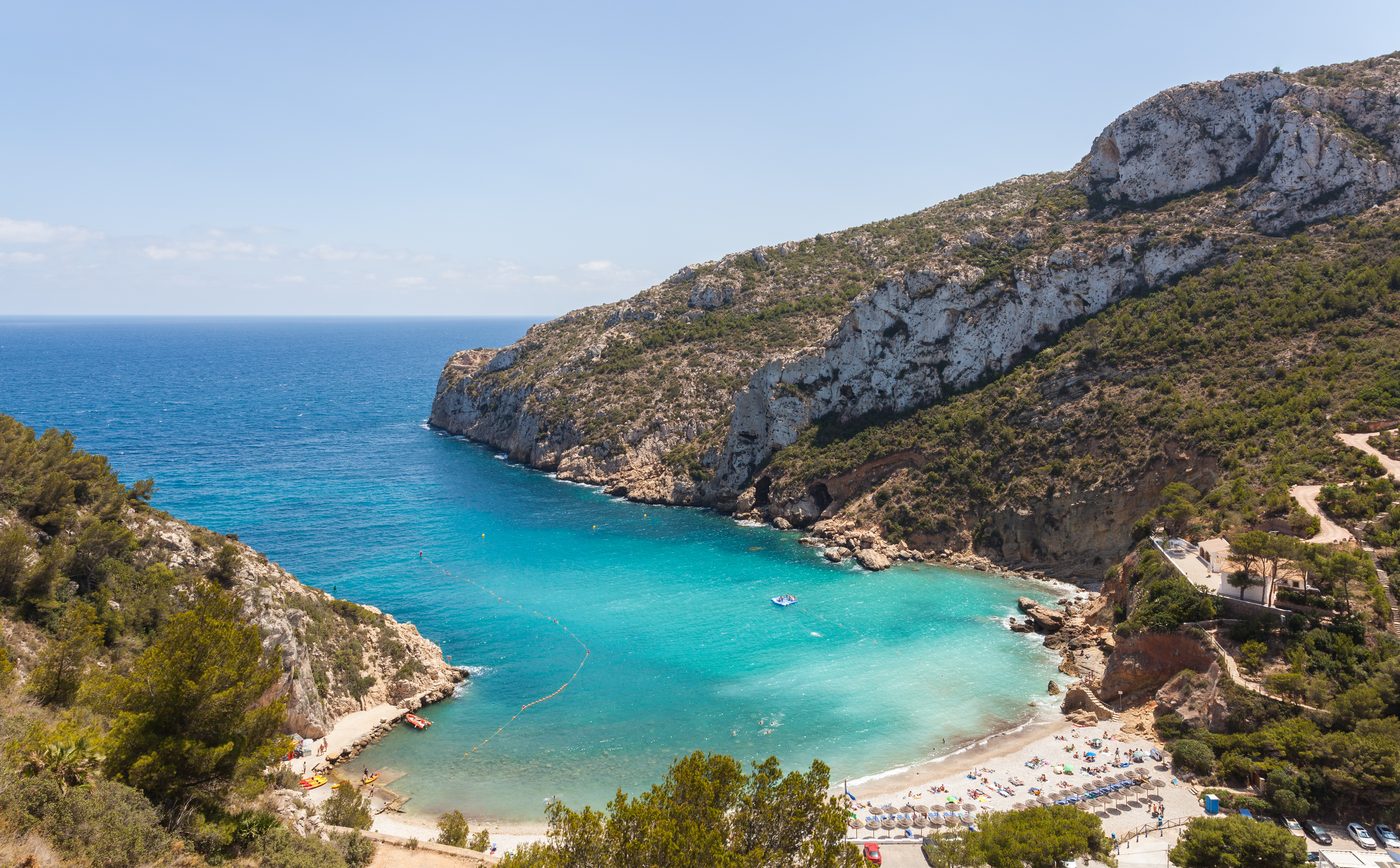
Just north of La Granadella, at the foot of the 16th-century Ambolo watchtower, a single dark mouth opens at sea level. Llop marí — “sea wolf” — is the old Valencian name for the Mediterranean monk seal, which once bred on this coast and sheltered in this cave; later generations of fishermen turned it into a legend about a monster that shredded their nets. Divers love it for a beam of light that drops through an opening in the vault on bright days.
This is another sea-only entry, and deliberately so: buoys across the entrance keep motor boats and jet skis out, so the last stretch is done swimming, by kayak or on a paddleboard. It’s a standard stop on every Granadella kayak tour, and one of the best half-day paddles in the province — in calm seas only, as the swell slaps hard at the rocks around the mouth.
Getting there: anchor off Granadella on sand (never the seagrass) or land a kayak on the beach, then paddle five minutes north under the tower.
7. Cala Llebeig — huts, smugglers and the south-west wind
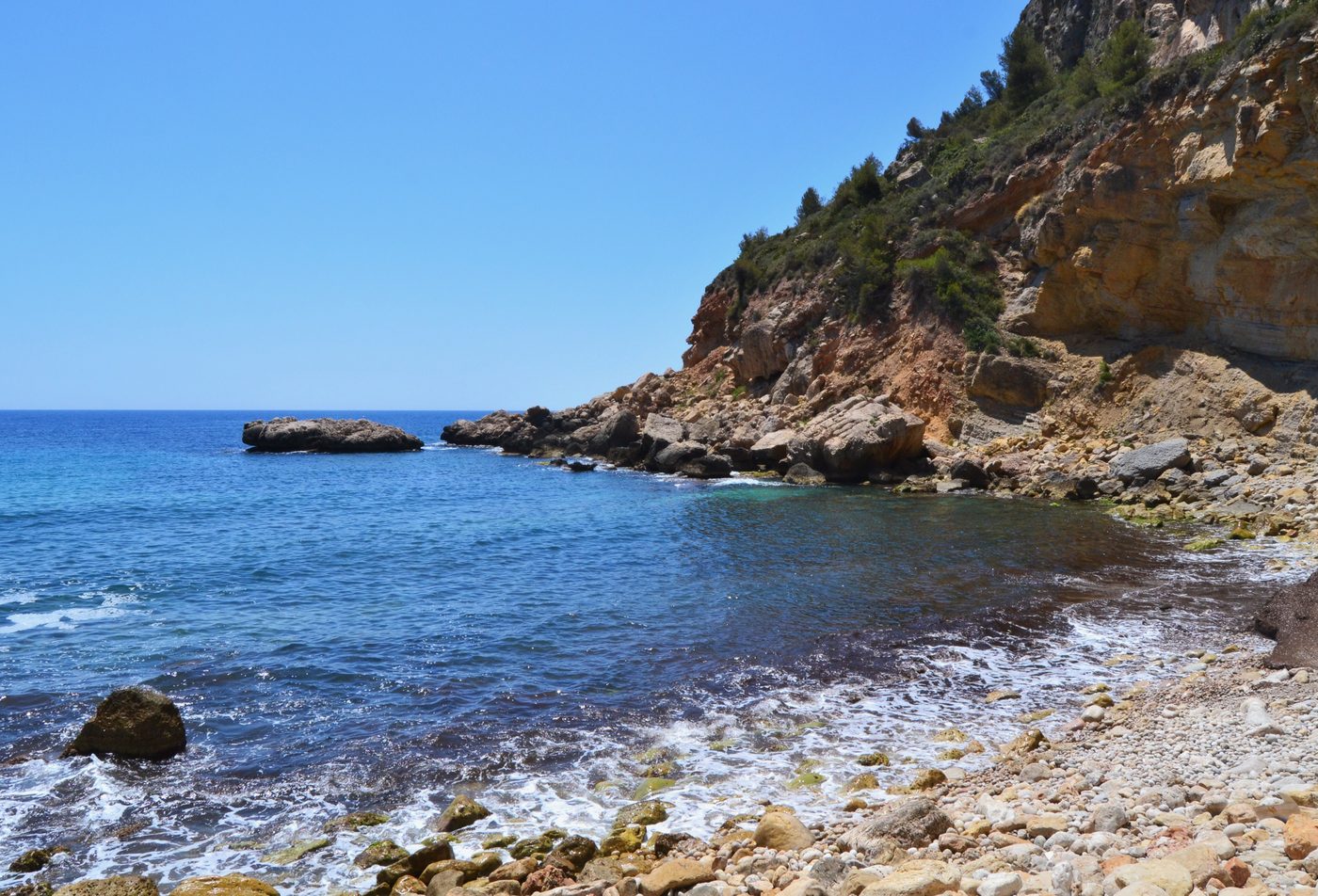
On the boundary between Benitatxell and Teulada-Moraira, at the mouth of the Barranc de la Viuda, Llebeig is the cove that time forgot: a rock-and-gravel shore with a huddle of old fishermen’s huts built into the first metres above the water, and the Caseta dels Carabiners — a customs post from the coast’s smuggling era — watching over them. No bar, no road, no services.
By land it’s a proper walk: the SL-CV 50 cliff route from Cala del Moraig runs 2.3 km each way with about 100 metres of climb — count on two to three hours round trip. By boat it’s an easy lunch stop on the run between Javea and Moraira, with decent shelter from anything northerly.
Getting there: by sea, midway between Moraira and the Moraig cliffs; by land, the coastal trail from Moraig. Anchor on sand patches well clear of the meadows.
8. Cala dels Testos — the cove the land route can’t tame
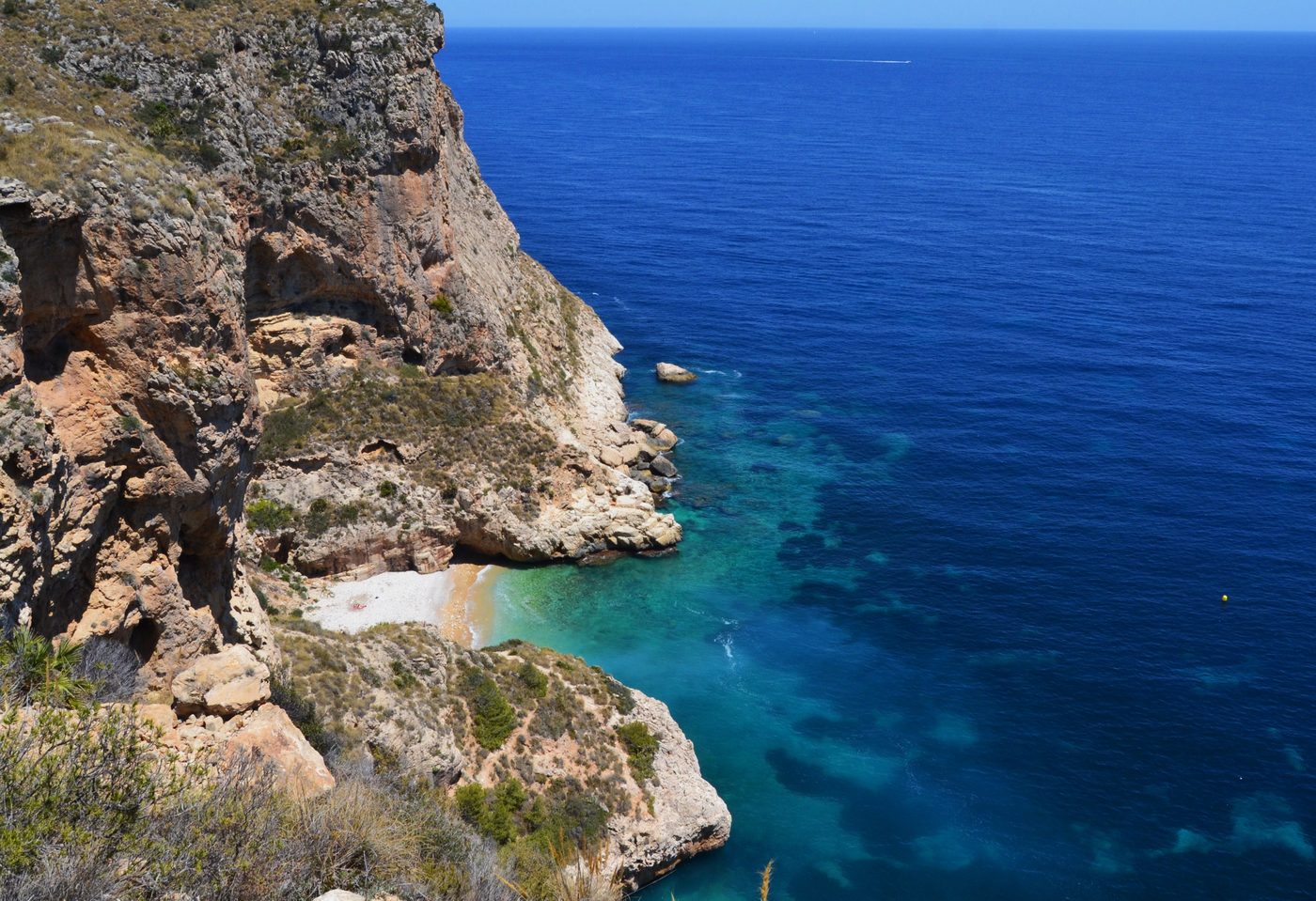
A 40-metre pebble crescent at the foot of Morro Falquí, where the Barranc de l’Infern — the “ravine of hell” — meets the sea. The name is gentler than the setting: testos are the clay pots cliff fishermen stored in the caves here to collect fresh water filtering out of the rock.
The land route is the most serious on this coast — a descent of the ravine ending in three fixed-rope sections of 8 to 15 metres, with rescues most summers. Unless you’re an experienced scrambler with your own kit, the sea is the sensible way in: it’s only about 400 metres by kayak or paddleboard from Cala del Moraig, and the snorkelling under the cliffs is superb.
Getting there: paddle round the point from Moraig, or anchor a boat off on sand — the cove shelves quickly and the floor is part seagrass, so pick your spot with the sounder.
9. Els Arcs — the rock arches of Cala Moraig
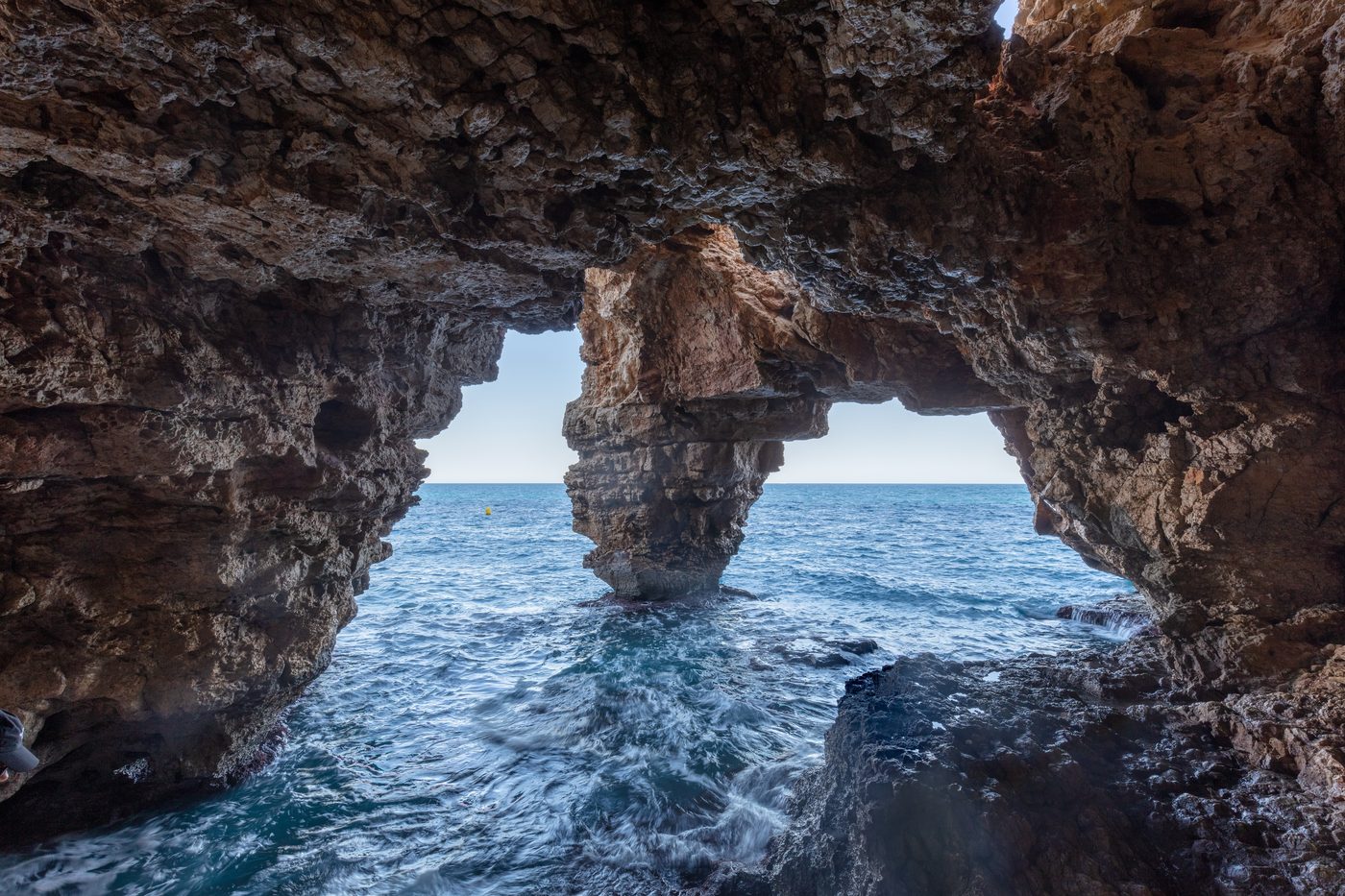
At the southern end of Cala del Moraig two great natural arches stand in the sea, with a skylight punched through the rock above them. The Cova dels Arcs is the sea mouth of an underground river — the Riu Blanc — and behind the visible cave lies a flooded karst system that is strictly the preserve of qualified cave divers. For everyone else, the arches themselves are the prize.
You can scramble to them over big, slippery boulders from the beach, but the classic view is from the water: swim or paddle through the arches on a flat-calm morning and the rock glows turquoise beneath you. Any swell at all and both approaches close out — this is a millpond-days-only stop.
Getting there: by sea, tuck in at the south end of Moraig. By land, note the summer access control on the Moraig road (1 April–15 October, €15/day for non-resident vehicles, bookable online) — another argument for arriving by boat.
Before you cast off: the rules on this stretch of water
The reason these coves are still worth writing about is that they’re protected — and the protection comes with real rules, actively enforced. The essentials for a day afloat out of Javea:
- The Cap de Sant Antoni marine reserve (the water between Denia and Javea, including the Cova Tallada): maximum 6 knots, no anchoring — moor only at the authorised eco-buoys — no fishing of any kind, no jet skis in the fishing-interest zone, and diving only with prior authorisation. Don’t pocket so much as a shell.
- Posidonia is untouchable. Anchoring on seagrass meadows is prohibited across the Valencian Community (Decreto 64/2022), and damaging a protected habitat under Ley 42/2007 carries fines from €3,001 up to €200,000. In September 2025 the Guardia Civil, checking Javea bay with an underwater viewer, filed eleven denuncias in a single sweep — several for anchoring on posidonia, and the rest for missing licence and insurance paperwork.
- The bathing strip: where a beach isn’t buoyed, the first 200 metres (50 m off rocky coast) is a bathing zone — 3 knots maximum and full care for swimmers. Buoyed zones are closed to craft entirely except the marked channels.
- Jet skis have their own rulebook: outside the bathing strip, daylight hours only, beach approaches perpendicular to shore at 3 knots — and they’re barred from the reserve’s core and buoyed out of caves like the Llop Marí.
- Portitxol strait: being closed to boats with marker buoys from 2026 under the town’s new mooring plan — round the outside of the island from now on.
Insurance for a day like this
A quick word from the day job, because it’s the paperwork side of exactly these trips. In Spain, third-party liability insurance is compulsory for craft with an engine over 3.7 kW or a hull over 2.5 metres — and for every jet ski, no exceptions. Marinas ask for the certificate to keep a berth, and as the September 2025 checks in Javea bay showed, the Guardia Civil asks for it afloat too.
Beyond the compulsory minimum, a proper boat policy in Spain adds hull damage, theft, salvage and — relevant around cliffs and caves — liability for passengers you take along. If you’re new to boating here, our guide to boat licences and the law in Spain explains which skipper qualification each boat needs, from the licence-free tier up. UK licence holders can check how their tickets map across in our Spanish vs UK boat licences comparison. Jet ski owners have a dedicated page at jet ski insurance in Spain, and larger vessels are covered on our yacht and superyacht insurance hub. Still deciding where to keep the boat? Our Costa Blanca mooring costs guide compares berth prices marina by marina, from Javea’s club moorings to Dénia’s superyacht berths.
We arrange all of it in English, from an office ten minutes from the Javea port — and we handle the claims as well as the quotes. (Curious what claim day actually looks like? Here’s how a marine claim works in Spain.)
Going afloat this summer?
Get a boat or jet ski quote in English from a local agency that knows these waters — and what the Guardia Civil checks on them.
Get a marine insurance quote → See what our boat policies coverFrequently asked questions
Strictly sea-only: the Cova dels Orguens under Cap de la Nau, the Cova del Llop Mari by Granadella (swim, kayak or paddleboard for the final stretch), and the arches at Els Arcs in any comfort. Cala Ambolo is closed by land, so it is boat-only in practice. Cala dels Testos is boat-or-ropes. Cova Tallada, Cala Sardinera and Cala Llebeig can be reached on foot, but only by proper trails - by boat is the easy way.
Yes, in the regulated season. In 2026 a free advance reservation is compulsory from 15 June to 15 October (plus the Easter and early-May weeks), booked through the Generalitat Valenciana portal at most 10 days ahead, with a maximum of five people per booking and a 90-minute stay. It applies however you arrive - on foot, by kayak or swimming. Licensed excursion companies hold their own permits, and motor boats must stay at the buoys outside the cave.
On sand, or at an authorised buoy - never on posidonia seagrass. Anchoring on the meadows is prohibited in the Valencian Community under Decreto 64/2022, with fines under Ley 42/2007 of up to 200,000 euros, and the Guardia Civil checks Javea bay with an underwater viewer. Inside the Cap de Sant Antoni marine reserve anchoring is banned outright - use the eco-buoys. If you can't identify the bottom, assume it's seagrass and move.
To most of the open ones, yes - with the rulebook in mind. Jet skis must stay outside the 200-metre bathing strip except to enter and leave perpendicular to the shore at 3 knots, ride in daylight hours only, and keep out of the marine reserve's restricted zone. Buoys physically bar them from sea caves like the Llop Mari. Third-party liability insurance is compulsory for every jet ski in Spain, owned or rented.
Not for the smallest tier: boats up to 5 metres with engines up to 15 hp (and sailing boats up to 6 metres) can be handled licence-free in daylight, up to 2 miles from a port or shelter - which comfortably covers Portitxol, Sardinera and the local bay. Anything bigger needs a Spanish qualification, from the titulin upwards. Our boat licences and law guide walks through the full ladder.
June and September are the sweet spot: warm water, settled mornings, and none of August's crowds or quota pressure. Whatever the month, go early - the caves need flat calm, and the afternoon sea breeze stirs up chop most summer days. In high season remember the Cova Tallada permit window (15 June to 15 October) and the paid vehicle control on the Cala Moraig road if you're meeting anyone arriving by land.
Third-party liability cover is compulsory for craft with an engine over 3.7 kW or a hull over 2.5 metres, and for all jet skis. Marinas require proof of insurance for a berth, and afloat checks do happen - the September 2025 Guardia Civil sweep in Javea bay included insurance paperwork among its denuncias. Comprehensive cover for the hull, theft and salvage is optional but sensible on this rocky coast.
Sources & references: Ajuntament de Xàbia — Cap de Sant Antoni marine reserve and Cala Sardinera; Cova Tallada 2026 reservation rules; RD 876/2014 (Reglamento General de Costas), art. 69 on bathing zones; RD 259/2002 on jet skis; Decreto 64/2022 del Consell on seagrass meadows; Ley 42/2007 on protected habitats.
Local reporting on the 2026 Portitxol buoy plan and the September 2025 posidonia checks from Xàbia al Dia and La Marina Plaza. Cove photos via Wikimedia Commons, credited and licensed per image caption. Access rules and permit windows change season to season — check locally before you go. Cover descriptions refer to the Generali policies we arrange at marine insurance in Spain; always check your own schedule. This guide is general information, not financial or legal advice.