Important Notice — Turner Insurance does not provide inheritance tax advice or services. This page is provided as an educational rough guide only, accurate as of 2026. For specific tax advice, consult a qualified gestoría, abogado or tax adviser in Spain.
Spain's inheritance tax (ISD — Impuesto sobre Sucesiones y Donaciones) is one of the most regionally varied taxes in the country. Where you live in Spain when you die determines the rules, rates and exemptions that apply to your estate — and the differences are enormous. This guide explains the rules region by region.
How Spanish Inheritance Tax Works — The National Rate
Spain's inheritance tax (ISD — Impuesto sobre Sucesiones y Donaciones) is not a flat rate. At national level it is a progressive tax with rates from 7.65% to 34%, calculated on the net value inherited by each individual beneficiary. Unlike the UK, the tax is paid by the heir, not the estate — each beneficiary calculates and files their own return separately.
📊
National base rate
Progressive scale from 7.65% on the first tranche up to 34% on amounts above approximately €797,000 per heir.
🏛️
Paid by the beneficiary
Each heir is taxed individually on what they receive — not a single tax on the whole estate. Filing is on Modelo 650 within 6 months of death.
🗺️
Regional reductions apply
Each of Spain's 17 autonomous communities sets its own bonifications and personal reductions. As of 2026, 11 regions offer 99%+ relief for direct family — reducing the effective rate to near zero.
⚠️
The multiplier (coeficiente)
A wealth multiplier can push the effective rate higher for distant relatives or heirs with significant pre-existing assets — in extreme cases for unrelated heirs, effective rates can exceed 80%. All the more reason to live in a generous region.
The key point: the national 7.65%–34% scale is the starting point — your autonomous community then applies its own bonifications and personal reductions on top of it. In Madrid, Andalusia, Murcia, Galicia, Cantabria, La Rioja and the Canary Islands, these regional reductions reduce the effective rate for direct family to approximately 0–1%. In Catalonia, the national scale with modest reductions means meaningful tax for larger estates. Where you are habitually resident in Spain when you die determines which regional rules apply to your entire estate.
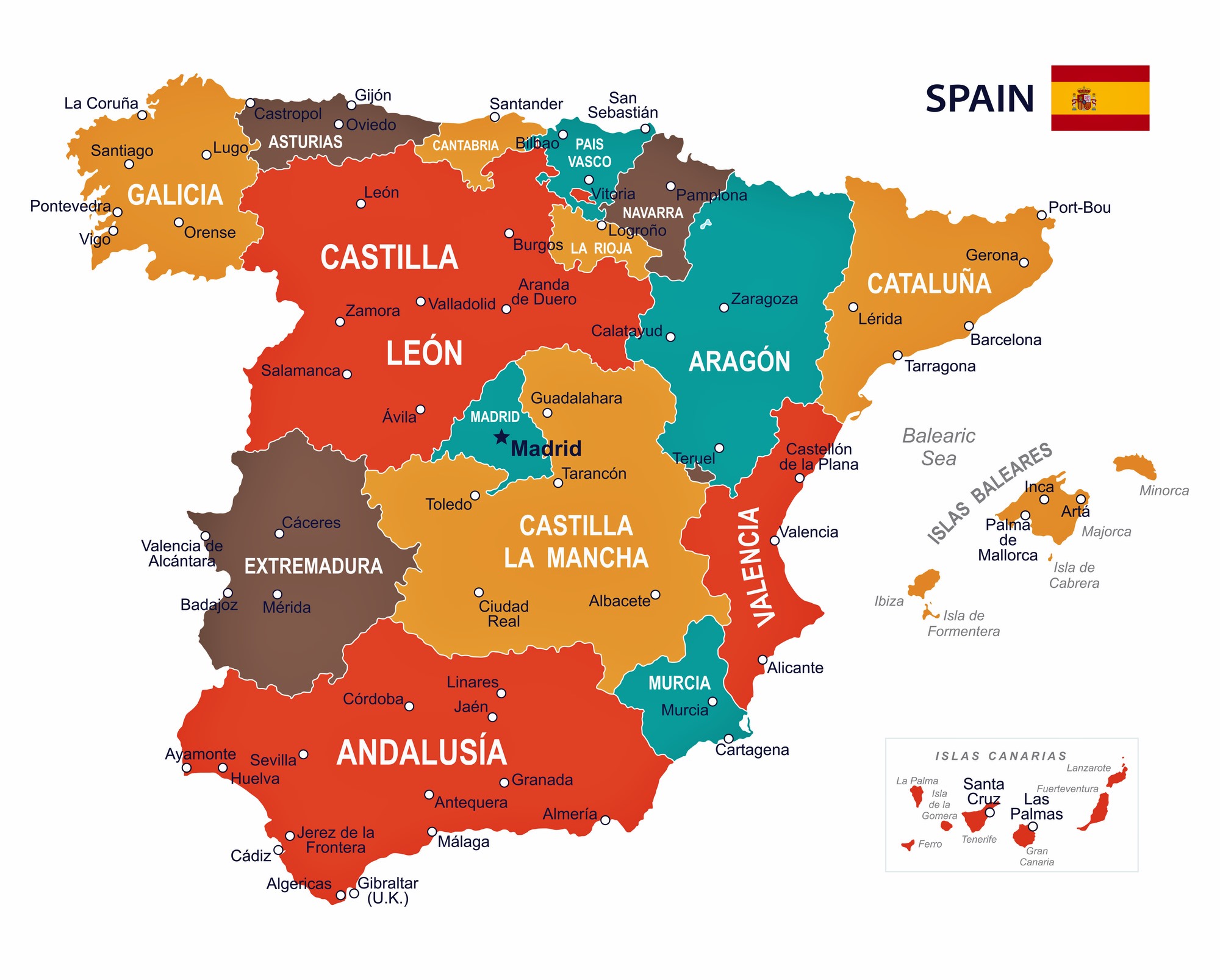
Choose Your Region — Click the Map
Click any of the seventeen blue pins on the map — Galicia, Asturias, Cantabria, País Vasco, Navarra, La Rioja, Aragón, Cataluña, Castilla y León, Madrid, Castilla-La Mancha, Extremadura, Valencia, Murcia, Andalusia, Balearic Islands or Canary Islands — to read its detailed 2026 inheritance tax guide. Hover over the region itself on the map to highlight it.
Use this calculator to estimate the life insurance cover your family would need — including an allowance for any inheritance tax liability based on your region. This is a rough guide only; speak to us for a personalised recommendation.
Estimated cover needed
⚠️ This is a rough estimate for guidance only — not financial advice. Speak to us for a free, personalised life insurance recommendation. 📞 Get a free quote →
Why This Matters for Life Insurance
Life insurance proceeds paid to named beneficiaries are subject to ISD in Spain. The region where the policyholder was habitually resident at the time of death determines the applicable rates. In Madrid, direct descendants pay effectively 0%. In Catalonia, they may pay 20%+ on larger amounts. This is why choosing the right life insurance structure and ensuring beneficiaries are named directly in the policy — not through a will — is so important.
Frequently Asked Questions — Inheritance Tax in Spain
Spain's inheritance tax (ISD — Impuesto sobre Sucesiones y Donaciones) is a national tax but its administration has been devolved to the 17 autonomous communities. Each region can set its own rates, exemptions, deductions and bonifications within national limits. This has led to enormous variation — Madrid effectively charges 0% for direct descendants while Catalonia has relatively high rates. Where you are habitually resident in Spain at the time of death determines which regional scale applies.
As of 2026, Madrid offers the lowest effective inheritance tax for direct descendants and spouses — a 99% bonification makes the rate effectively 0%. Andalusia and the Basque Country also offer very generous treatment. Catalonia is generally considered the most expensive region for inheritance tax for most family situations.
Yes — life insurance proceeds paid directly to named beneficiaries are subject to ISD in the region where the policyholder was habitually resident. The regional rules (rates, exemptions, bonifications) apply to the life insurance payout in the same way as other inherited assets. See each regional page for specific details and always consult a tax adviser for your specific situation.
Yes — this is the most important practical step for minimising ISD on life insurance proceeds. By naming beneficiaries directly in the policy (rather than leaving proceeds to pass through your estate or will), the proceeds are treated more favourably under Spanish ISD law in most regions. Always discuss this with your insurance broker and a tax adviser.
This information is accurate to the best of our knowledge as of 2026. Regional inheritance tax rules in Spain change periodically as regional governments update their legislation. Always verify current rates and exemptions with a qualified tax adviser before making planning decisions. Turner Insurance does not provide tax advice.
ISD divides heirs into four grupos: Group I — direct descendants under 21 (most generous treatment); Group II — direct descendants aged 21+, spouses and ascendants (also well treated in most regions); Group III — siblings, aunts, uncles, nephews and nieces (less generous); Group IV — more distant relatives and unrelated persons (least favourable, often paying near the full national rate). The group determines both the base exemption and which regional bonifications apply.
A bonificación is a percentage reduction applied to the ISD tax bill after the tax has been calculated. For example, a 99% bonificación means the heir pays only 1% of the calculated tax — effectively near-zero. Madrid, Andalusia, Cantabria, Castilla y León, La Rioja and the Canary Islands all offer 99%+ bonifications for direct family. Bonifications are set by each autonomous community and can change when regional governments update their legislation.
Yes — non-residents who inherit Spanish property are subject to ISD regardless of where they live. Until 2015, non-EU residents were taxed under the national (federal) scale rather than the more generous regional rates. A European Court of Justice ruling changed this — EU and EEA residents can now choose whichever scale (national or regional) is more favourable. Non-EU residents (including UK nationals post-Brexit) may still face less favourable treatment depending on their specific situation. Always take advice from a qualified Spanish tax adviser.
Yes — in most cases a formal ISD declaration must be submitted to the relevant regional tax authority within six months of the date of death, even if the bonifications or exemptions mean zero tax is payable. Failure to file on time can trigger surcharges and interest even if the underlying tax liability is nil. An extension of six months can sometimes be requested. Your gestoría or tax adviser handles this process.
For ISD purposes, the deceased's habitual residence is the region where they spent the most days during the five years immediately before death. It is not simply where they were registered on the padrón or where their property is located. If someone split time between two Spanish regions, the region with the most days of residence in that five-year period takes precedence. This matters because it determines which regional scale — and which bonifications — apply to the entire estate, not just Spanish-based assets.
 Galicia
Asturias
Cantabria
País Vasco
Cataluña
Extremadura
Madrid
Valencia
Andalusia
Navarra
La Rioja
Aragón
Castilla y León
Castilla-La Mancha
Murcia
Balearic Is.
Canary Is.
Galicia
Asturias
Cantabria
País Vasco
Cataluña
Extremadura
Madrid
Valencia
Andalusia
Navarra
La Rioja
Aragón
Castilla y León
Castilla-La Mancha
Murcia
Balearic Is.
Canary Is.